
ZHI YAN CANDY MACHINERY Co.,Ltd Leading technology Candy making machinemanufacturers
Contact No.:+86 18221614363
Email:candymachinery@qq.com
Contact No.:+86 18221614363
Email:candymachinery@qq.com
Adr :industrial zone, shanghai
Phone : +86 18221614363
Email : candymachinery@qq.com
Tel : +86 18221614363
Issues with Clogged Nozzles, Intermittent Feed, Material Shortages, and Defective Candy Bodies on lollipop production line
During the pouring process on lollipop production lines, the candy mixture flows intermittently, the output size decreases, and the poured candy bodies may have missing corners, material shortages on one side, empty molds, or other defects; nozzles frequently become clogged, requiring frequent disassembly to clear them, but the problem recurs shortly after cleaning.
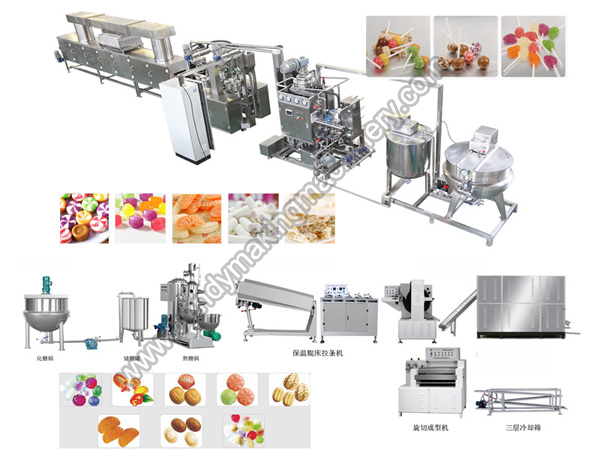
Sugar syrup is a high-viscosity, high-temperature molten material. Blockages fall into two main categories: blockages caused by physical impurities and those caused by abnormal physical properties of the sugar syrup itself, leading to blockages or unstable output; there are also issues related to the pouring system equipment and process parameters.
I. Classification of Main Causes
1. Impurities, caramelized particles, and burnt residue in the sugar syrup (common causes of nozzle blockages)
1) Caramelized particles formed during sugar boiling: Sugar caramelization occurs on the inner walls of the boiling kettle, heat exchange surfaces, vacuum chambers, and pipe walls, producing fine caramelized particles. These flow with the sugar paste to the pouring nozzle, becoming lodged in its small orifices, resulting in reduced flow and intermittent feed interruptions. During prolonged continuous production, sugar scale continuously accumulates and flakes off, causing increasingly frequent nozzle blockages.
2) Damaged filter screen: If the filter screen is damaged after sugar boiling and before pouring, caramel particles and impurities enter the pouring head directly.
3) Foreign contaminants: Rust particles from equipment, fragments of sealing gaskets, and wear debris from the agitator fall into the sugar syrup.
2. Abnormal sugar syrup temperature and viscosity, causing unstable flow and nozzle blockages due to cold syrup
1) The overall temperature of the sugar syrup is too low, increasing its viscosity and reducing its flowability. Rapid heat loss occurs at the pouring nozzle, causing localized cooling of the syrup at the nozzle opening. The syrup partially solidifies, gradually narrowing the discharge opening, resulting in nozzle blockages and intermittent discharge.
2) Excessively high temperature: Over-inversion of the sugar causes the syrup to become sticky and prone to caramelization, leading to carbon buildup and scaling on the inner walls of the pouring nozzle, which gradually reduces the orifice diameter.
3) Insulation failure: Insufficient insulation in the jacket of the pouring head, distributor, and pouring nozzle creates localized cold spots, causing the sugar paste to pre-solidify inside the nozzle. This is particularly common during brief shutdowns, when the nozzle tip cools rapidly, leading to immediate blockage upon restarting the machine.
3. Blockages Caused by Precipitation and Crystallization in the Material System
1) Excessive acid addition or excessively high feed temperatures can cause extensive sucrose conversion, leading to sugar paste “re-sanding”—the formation of fine sugar crystals that accumulate in the pouring nozzle and cause blockages. As discussed earlier regarding the process for adding flavorings, colorants, and acids, improper timing of acid addition not only causes flavor fluctuations but can also trigger nozzle blockages during pouring.
2) Insoluble substances in colorants and acid solutions, as well as acid crystallization particles, are carried into the sugar paste and accumulate in the small orifices of the pouring nozzle.
4. Issues with the Pouring System Equipment (Material Interruption or Shortage—Not Necessarily Due to a Clogged Nozzle)
1) Unstable Feed Pressure
Fluctuations in pressure during sugar boiling, discharge, pump operation, and distribution chamber operation—with pressure fluctuating between high and low—cause the flow rate from the pouring nozzle to vary erratically. As a result, the mold receives inconsistent amounts of sugar syrup, leading to defective or underfilled candy pieces.
2) Wear, Deformation, or Burrs on the Pouring Nozzle
Prolonged exposure to high-temperature sugar slurry causes wear to the inner bore of the pouring nozzle and deformation of the outlet; alternatively, the inner bore may be scratched during disassembly and cleaning, causing sugar slurry to adhere to the walls and accumulate, gradually narrowing the passage and leading to frequent blockages.
3) Poor venting in the pouring distribution chamber
Air bubbles accumulate inside the distribution head; when these bubbles reach the pouring nozzle, they cause momentary interruptions in material flow, preventing the mold from filling completely and resulting in defective candies.
4) Nozzle installation issues: Misaligned seals or shims with inner diameters that are too small cause throttling, resulting in insufficient material flow; in multi-nozzle setups, improperly installed individual nozzles lead to reduced output.
5. Process Operations and Downtime Issues
1) During brief production line downtime, if the nozzles are not kept warm and not purged by dripping, the sugar at the nozzle tip cools and solidifies, causing immediate blockages upon restart.
2) Cleaning the pouring nozzles by poking them with hard metal objects scratches the inner walls of the nozzles, making them more prone to sugar buildup and scaling in subsequent operations.
3) Mismatch between pouring speed, mold cycle time, and output flow rate: The output cannot keep up with the mold’s travel speed, resulting in incomplete filling of the candy.
II. Comprehensive Solutions
(1) Reducing Impurities and Caramel Particles at the Source to Prevent Nozzle Blockages Upstream
1. Enhance Filtration Protection
Install two filtration stages between the sugar boiling and pouring processes: a first stage for coarse filtration and a second stage using a fine mesh filter (80–120 mesh) to trap caramel particles. Regularly inspect the filters for damage; replace them immediately upon discovery of any damage—never continue production with damaged filters. Replace filters regularly; do not wait until they are completely clogged.
2. Regular Equipment Cleaning: Regularly remove sugar scale from the boiling kettle, vacuum tank, transfer piping, and pouring distribution head; at the end of each continuous production shift, thoroughly remove caramelized sugar layers from the inner walls to prevent caramel chunks from falling off.
3. Control the Acid Addition Process: Strictly add acid at 105–115°C to avoid excessive conversion and sugar recrystallization caused by adding acid at high temperatures; the acid solution must be free of crystalline particles, and the mother liquor must be kept at a constant temperature.
(II) Optimization of Temperature and Heat Preservation Systems (Critical)
1. Strict Control of Sugar Paste Process Temperature: The temperature of the sugar paste entering the pouring and distribution head must be stable and not too low; adjust according to the formula—generally, the pouring temperature of the sugar paste should be 110–120°C (fine-tune based on the hard candy formula), and the smaller the temperature fluctuation, the better.
2. Inspection of Heat Preservation for Pouring and Distribution Head and Nozzle Jackets: Ensure the temperature of the heat transfer medium is stable and eliminate local cold spots; Ensure that all pouring nozzles are effectively insulated as a whole; the nozzle tips must not be exposed to significant heat loss.
3. Procedures for brief downtime: During short-term shutdowns, maintain a small drip of syrup from the pouring nozzle to prevent the syrup at the tip from cooling and solidifying; during prolonged shutdowns, drain the syrup from the dispensing head.
Common Mistake: Insulating only the dispensing chamber while neglecting the ends of the pouring nozzles, causing the syrup at the nozzle tips to cool rapidly and solidify.
(III) Pouring Nozzle Maintenance and Accessories Management
1. Do not forcefully probe the pouring nozzles with steel wire or screwdrivers; prioritize hot-melt flushing for blockages. Hard objects can scratch the inner bore, leading to repeated material buildup and blockages.
2. Maintain a record of nozzle wear and tear: High-temperature flushing can wear down the nozzle bore; replace the nozzle if the bore diameter increases or becomes deformed. Replace immediately if the inner bore has scratches or scale that cannot be cleaned.
3. Select the correct gasket during installation; ensure the gasket’s inner diameter is no smaller than the nozzle bore to prevent throttling. Ensure each nozzle is properly installed to maintain a leak-free seal.
(IV) Pressure and Venting: Resolving Intermittent Material Interruptions and Material Shortages Caused by Air Bubbles
1. Maintain stable feed pressure: Ensure stable pressure during sugar boiling and discharge, as well as for the transfer pump, to avoid significant pressure fluctuations; pressure fluctuations directly cause erratic discharge rates.
2. Install vent valves on the pouring distribution head to vent air at regular intervals, eliminating air bubbles accumulated inside the chambers; air bubbles are the primary cause of many intermittent feed interruptions—even if the nozzle appears unclogged, the mold will not fill completely once bubbles are released.
3. Multi-nozzle pouring production lines: Perform consistency checks on the flow rate of each pouring nozzle to ensure uniform output from every nozzle and prevent material shortages at individual nozzles.
(V) Production Operation and Inspection
1. Preheat the pouring head and nozzles before starting the machine. Only feed the sugar paste once the entire machine has reached the process-set temperature; never feed sugar paste into a cold machine.
2. Production process patrol inspection: Observe the flow status of each nozzle; if stringing or a decrease in flow rate occurs, address the issue promptly to prevent the production of a large number of defective candy pieces.
3. Match the molding cycle: Ensure the molding flow rate, molding time, and mold travel speed are properly synchronized; if the flow rate is insufficient, adjust the process settings—do not forcefully increase production speed.
III. Rapid On-Site Diagnosis and Troubleshooting
1. Poor output from all nozzles simultaneously: Most likely caused by low sugar paste temperature, fluctuating feed pressure, sugar paste sand contamination or abnormal viscosity, or air trapped in the distribution head.
2. Individual nozzles are clogged while others function normally: Particulate impurities are lodged in a single nozzle; the nozzle is worn or scratched; the nozzle’s heat retention has failed; or there is an issue with the installation gasket.
3. Intermittent material shortages, with performance fluctuating between good and bad: Prioritize checking for air bubbles in the distribution head, pressure fluctuations, or fine burnt particles in the sugar paste that intermittently clog the orifices.
4. Nozzles clog shortly after cleaning: This is caused by burnt particles or impurities in the sugar syrup source, or by recrystallization of the syrup; it is not a problem with the pouring nozzles themselves.
IV. Common Misconceptions
1. Blindly increasing the sugar syrup temperature to improve flowability: Excessively high temperatures accelerate caramelization, producing more burnt particles and causing increasingly severe nozzle blockages.
2. Forcing the nozzle open with a steel wire when it clogs scratches the inner wall of the nozzle, leading to a vicious cycle of frequent blockages.
3. Cleaning only the nozzle while neglecting to clean sugar residue from the upstream boiling process and piping allows burnt particles to continue flowing in.
4. Ignoring air venting from the distribution head and mistaking air bubbles causing material interruptions for nozzle blockages.
All rights reserved:ZHI YAN CANDY MACHINERY Co.,Ltd SitemapSitemapManufacturer Candy making machine candy production line Toffee production line biscuit production line lollipop production line Gummy production line chocolate production line chewing gum production line Popping boba production line


