
ZHI YAN CANDY MACHINERY Co.,Ltd Leading technology Candy making machinemanufacturers
Contact No.:+86 18221614363
Email:candymachinery@qq.com
Contact No.:+86 18221614363
Email:candymachinery@qq.com
Adr :industrial zone, shanghai
Phone : +86 18221614363
Email : candymachinery@qq.com
Tel : +86 18221614363
The problem of sugar boiling temperature in lollipop candy production line equipment
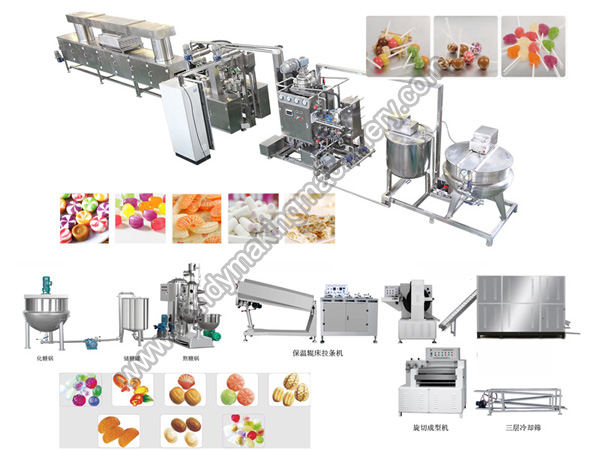
The sugar boiling equipment of the automatic gel fudge hard candy lollipop production line equipment: the set temperature cannot be reached, and the syrup moisture is high. What is the reason? Check one by one according to the following conditions.
We need to understand the principle of boiling candy first before we can solve the problem. Zhengzhou Zhenyan Machinery Equipment Factory will solve related problems for you
The goal of sugar boiling in candy equipment is to evaporate the water inside the sugar paste.
If the temperature control display does not reach the set temperature, it will cause moisture to not be removed, resulting in excessive moisture content, stickiness, easy sand return, and shortened shelf life of the finished product.
Sugar boiling pots are divided into two categories: vacuum sugar boiling machines (mainstream hard sugar) and atmospheric pressure sugar boiling pots. The following is a general investigation.
Vacuum sugar boiling: If the vacuum degree is insufficient, it will cause the boiling point of water to decrease, and the sugar paste cannot reach the temperature; Insufficient heat source/poor heat exchange will result in insufficient heating capacity; Another situation is inaccurate temperature measurement, which creates the illusion of 'insufficient temperature'.
1、 Firstly, distinguish whether it is a false temperature measurement or a low temperature real sugar paste
1. Temperature sensor malfunction (high-frequency false alarm malfunction)
1) The thermocouple/PT100 temperature probe has formed sugar deposits, and the sugar coke layer is insulated by sugar deposits. The temperature measured by the probe is much lower than the true temperature of the sugar paste. The control system continues to heat up, but the display does not reach the set value.
Solution: Remove the probe, polish and clean the sugar scale; Regular cleaning; The probe should be immersed in the main body of the sugar paste and should not be suspended or attached to the pot wall.
2) The installation position of the probe is unreasonable
Installed in the steam interlayer and above the liquid level in the steam zone, without contact with flowing sugar paste, the reading is low.
3) Temperature control instrument parameter drift and compensation error
Calibrate the temperature control meter and compare the measured sugar paste temperature with a portable infrared thermometer/handheld immersion thermometer.
Verification: Use an independent thermometer to directly measure the sugar paste itself.
Actual measured temperature ≈ instrument temperature: it belongs to insufficient heating due to actual heating
The measured temperature is significantly higher than the instrument reading: temperature measurement system malfunction
2、 Key inspection of vacuum sugar boiling machine models (continuous hard sugar boiling pot, intermittent vacuum sugar boiling tank)
Fault direction
1: Insufficient vacuum degree (common)
Vacuum sugar boiling relies on negative pressure to reduce the boiling temperature of water and enhance dehydration; Due to the vacuum difference, water vapor cannot be expelled, heat is carried away by water vapor, making it difficult for the sugar paste to heat up, and the moisture content remains high.
Checklist:
1. Vacuum pump malfunction
Water ring vacuum pump: insufficient water supply pressure, high water temperature, impeller scaling; Oil rotary vane pump: oil deterioration, clogged intake filter element.
2. Pipeline leakage
The sealing gasket of the pot lid is aging, and there are leaks in the manhole flange, sight glass, discharge valve, feed pipeline, and condenser pipeline; Air entering disrupts the vacuum.
Leak detection: Vacuum holding test, close all inlet and outlet ports to see if the vacuum can be maintained.
3. Poor heat exchange of condenser
The cooling water flow rate of the vacuum system condenser is insufficient, the water temperature is too high, and there is scale on the pipe wall. The water vapor cannot condense, and the partial pressure of the steam in the tank increases, making it difficult to pull up the vacuum.
4. Blockage of exhaust pipe
The sugar vapor generated by boiling sugar carries sugar mist, which accumulates and adheres to the pipeline for a long time, reducing the ventilation cross-section.
Fault direction
2: Insufficient supply of heating source (mostly steam type sugar boilers)
Most sugar boiling equipment uses interlayer steam heating
1. The steam pressure does not meet the equipment requirements (generally, boiling sugar requires 0.6~0.8MPa saturated steam)
Insufficient gas supply in the boiler room, malfunction of pressure reducing valves in pipelines, poor insulation of steam pipelines, and inability to drain condensate water.
2. Water accumulation in the interlayer
The condensed water in the interlayer cannot be discharged in a timely manner, and the water occupies the heat exchange space. The steam cannot contact the pot wall, and the heat exchange efficiency drops sharply.
Inspection: The interlayer drain valve is blocked or malfunctioning! The drain valve is a high-risk failure point.
Phenomenon: There is a knocking sound in the interlayer, slow heating, and inability to reach temperature for a long time.
Solution: Inspect/replace the drain valve, install a bypass drain valve for regular drainage.
3. Scale formation on the inner wall of the interlayer (for hot water/thermal oil heating models)
Scale insulation prevents heat from transferring to the sugar paste.
Fault direction
3: Process and feed parameter issues
1. Excessive feed flow rate (continuous sugar boiling line)
The feeding speed of sugar paste exceeds the evaporation capacity of the equipment, and the residence time is insufficient, so there is no time to heat up and dehydrate.
Measure: Reduce the feed flow rate appropriately and extend the boiling time.
2. The initial moisture content of the raw materials is too high
The pre-treatment and concentration of syrup are not sufficient, and the basic moisture content entering the sugar boiling machine is too high, exceeding the equipment load.
3. Abnormal mixing system
The stirring speed is too low, the stirring blade is sticky with sugar, the heat exchange of the sugar paste is uneven, the local temperature is low, and the overall dehydration effect deteriorates.
3、 Atmospheric pressure sugar pot (gummies, some traditional candies)
Under normal pressure, the boiling point of water is 100 ℃. To raise the sugar paste above 140 ℃, continuous evaporation is necessary to remove the water;
Common reasons for difficulty in heating up:
1. Insufficient output power of combustion engine/thermal oil furnace;
2. Caramel deposits accumulate at the bottom of the pot, providing insulation;
3. Opening the lid, a large amount of cold air entering, and continuous heat loss;
4. Poor dehumidification and smoke exhaust, accumulation of water vapor in the pot, and inhibition of water evaporation.
4、 Chain effect and judgment criteria of high moisture content in sugar paste
Temperature not rising → Insufficient evaporation power of water → Excessive water content:
Hard candy standard finished product moisture: ≤ 3.0% or so; The moisture content of the sugar paste at the end of boiling usually needs to be controlled between 1.5% and 2.5%
For every 3-5 ℃ decrease in temperature, the endpoint moisture will significantly rise.
Important reminder: Do not simply forcefully raise the set temperature!
If the vacuum is insufficient, simply increasing the steam pressure and forcibly heating can easily cause localized caramelization, darkening of color, caramel flavor, and sand return in the sugar paste.
5、 Recommended standard screening sequence
1. Calibrate the temperature probe to confirm that it is a true low temperature, not a false temperature measurement
2. Check the vacuum system: whether the vacuum gauge reading reaches the rated vacuum of the equipment; Conduct a pressure holding test; Check the vacuum pump, cooling water, and drain valve
3. Check the heat source: steam pressure, drain valve, whether there is water accumulation in the interlayer, and pipeline insulation
4. Check the seal: whether there is any air leakage in the pot cover and valve flange
5. Continuous production line: check the feed flow rate, syrup incoming moisture, and stirring operation status
6. Cleaning: probe to remove sugar scale, interlayer to remove scale, vacuum pipeline to clean sugar stains, condenser to remove scale
6、 Temporary adjustment measures
1. Reduce the feeding speed appropriately and extend the boiling residence time;
2. Ensure sufficient and low-temperature cooling water for the vacuum pump;
3. Fully open the interlayer drain valve to discharge water and eliminate accumulated water in the interlayer;
4. Reduce frequent opening of equipment to prevent air leakage and heat loss;
5. Strictly control the concentration of the preceding syrup and reduce the initial moisture content of the feed.
7、 Fault case reference
Case 1: The instrument temperature always differs by 5 ℃ and cannot reach the set value, resulting in high moisture content
The probe wrapped around sugar deposits, and after cleaning, the temperature returned to normal.
Case 2: Normal steam pressure, slow heating, and inability to increase vacuum
The interlayer drain valve is blocked, causing a large amount of condensed water to accumulate in the interlayer.
Case 3: Intermittent sugar boiling has a normal temperature rise in the early stage, but the temperature cannot rise in the later stage
The vacuum pipeline is blocked by long-term accumulation of sugar mist, resulting in poor exhaust.
All rights reserved:ZHI YAN CANDY MACHINERY Co.,Ltd SitemapSitemapManufacturer Candy making machine candy production line Toffee production line biscuit production line lollipop production line Gummy production line chocolate production line chewing gum production line Popping boba production line


