
ZHI YAN CANDY MACHINERY Co.,Ltd Leading technology Candy making machinemanufacturers
Contact No.:+86 18221614363
Email:candymachinery@qq.com
Contact No.:+86 18221614363
Email:candymachinery@qq.com
Adr :industrial zone, shanghai
Phone : +86 18221614363
Email : candymachinery@qq.com
Tel : +86 18221614363
How to deal with uneven thickness of oil spray in the biscuit production line
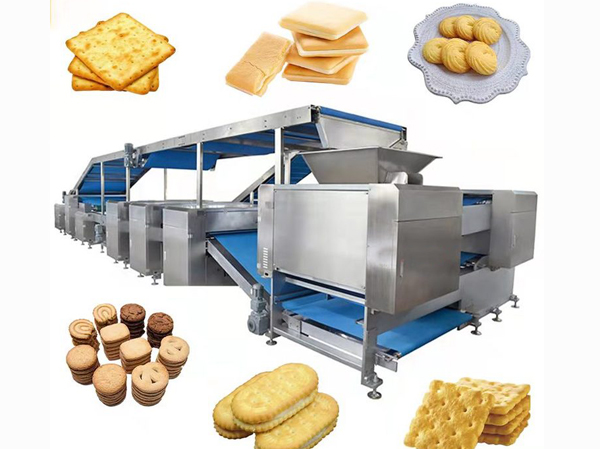
The reasons for uneven oil spray thickness on the surface of biscuits processed by the biscuit production line
(local oil brightness, local oil shortage) can be divided into four main categories: unstable oil supply pressure, atomizing nozzle failure, biscuit arrangement/transportation problems, and fan field interference. First, distinguish between two typical phenomena:
On the same line, some cookies have a lot of shiny oil, while others are dry and white without oil
2. A single cookie has one side with more oil and the other side with less oil, resulting in a color difference between the left and right sides
1、 Oil supply system pressure and oil temperature fluctuations
1. Unstable oil pump pressure: The pressure of the gear pump/diaphragm pump fluctuates, and there is no stabilizing tank; There are bubbles in the pipeline, air enters the oil circuit, and fuel injection is intermittent.
2. Large changes in oil temperature: Low oil temperature can cause high viscosity, less oil output, and poor atomization of the oil; Excessive temperature can cause the oil to become thinner, resulting in a large instantaneous oil output; There is no constant temperature insulation device.
Recommended fuel injection temperature: 45-55 ℃ (adjusted according to the type of grease), with constant temperature throughout the entire process.
Rectification method: Install stabilizing valves and pressure buffer tanks; Oil circuit exhaust; The oil tank is heated and temperature controlled with electricity, and the oil temperature remains constant; Filter grease to prevent impurities from clogging the nozzle.
2、 Malfunction and unreasonable arrangement of the nozzle itself
1. Some nozzles are blocked or partially blocked: some do not produce oil/the oil output is small; Some nozzles have a higher flow rate and larger oil droplets, resulting in shiny oil spots.
2. Inconsistent adjustment of nozzle atomization air pressure: The compressed air pressure of each nozzle is not individually adjusted; The air pressure is too low, resulting in poor atomization (large oil droplets), while the air pressure is too high and the oil mist cannot be blown up.
3. Incorrect nozzle height and angle: The nozzle is too far/too close to the cookie; The spraying angle does not cover the entire width of the mesh belt, with excessive overlapping spraying in the middle and insufficient spraying on both sides.
Debugging standards:
-A row of nozzles should evenly cover the width of the mesh belt, with a small amount of overlap in the spraying area, and not too much overlap when adding fuel;
-Each nozzle has independent pressure regulation; Regularly disassemble and clean the nozzle, equipped with cleaning tools;
-The atomization pressure is not equal to the oil supply pressure, and the oil pressure is slightly lower than the air pressure to form a fine oil mist.
3、 Compressed air source issue
1. Fluctuations in air compressor pressure and pressure drop in pipelines; Compressed air contains water and oil, leading to unstable atomization;
2. The thickness of the trachea is unreasonable, and there is insufficient gas supply from the distal nozzle.
Install oil-water separator and gas storage tank; Bolding the main road; Each spray gun is equipped with an independent pressure regulating filter.
4、 The arrangement and posture of cookies on the mesh belt interfere with the fuel spraying effect
1. Uneven density of cookies: cookies are stacked and piled up, and the lower layer of cookies are blocked and cannot be sprayed; Sparse oil mist falling entirely on the biscuits will cause a large amount of oil to shine brightly.
2. The cookies are warped, curled, and stand up: there is more oil spray on the side and less oil on the front; Biscuits block each other to form a "shadow zone" and lack oil.
The front-end material is dispersed and laid flat in a single layer, leaving even gaps between the cookies; Reduce warping deformation (optimization of baking and cooling processes).
5、 Side blowing/hot air interference with oil mist
The fan, oven hot air, and cooling air near the oil spraying area blow the oil mist away: one side of the oil mist is blown away with less oil, while the other side accumulates a large amount of oil mist.
Add a windshield to the fuel injection station to isolate the airflow; The oil spraying process should be kept away from strong cold/hot air vents; After spraying oil, turn on the strong cooling fan.
6、 Conveyor belt speed fluctuation
The production line speed fluctuates: Slow speed will result in longer fuel injection time and more shiny oil on top; Fast speed will result in shorter transit time and lower fuel consumption.
Stabilize the speed of the entire line's frequency converter and avoid frequent speed adjustments; The fuel injection system is synchronized with the host speed through variable frequency linkage control. As the speed changes, the fuel supply flow rate is automatically adjusted synchronously.
7、 Defects in the fuel injection method itself
1. Old style overflow roller dipping in oil: The thickness of oil on the roller surface is uneven, and there is excessive oil accumulation at both ends of the roller; The gap between the scraper blades is not consistent on both sides, with thick oil on one side and thin on the other.
2. Centrifugal oil slinger: Unstable rotational speed leads to fluctuations in oil slinging volume.
Quick fault diagnosis method
1. Fixed positions with long-term low oil may be due to nozzle blockage/angle deviation
2. More oil in the middle and less oil on both sides may be due to insufficient coverage of the nozzle and overlapping fuel injection in the middle
3. One batch of oil is large, and the next batch of oil is small, which may be due to unstable oil temperature and pump pressure
4. The lack of oil in densely packed areas of cookies and the shiny oil in empty spaces may be due to material obstruction or arrangement issues
On site step-by-step debugging operation sequence
1. Run the fuel injection system without load, observe whether the oil mist on the entire surface is continuous and uniform, and clean the clogged nozzles
2. Set the constant temperature oil temperature to 45-55 ℃, exhaust the oil circuit, and stabilize the oil pressure and air pressure
3. Fine tune the nozzle pressure, height, and spray angle one by one to ensure consistent horizontal fuel volume and no overlapping or excessive fuel injection
4. Turn off the surrounding interference fan and install a windshield
5. Conduct a trial spraying and observe the surface of the cookies; Adjust the material arrangement to ensure uniform single-layer distribution
6. Lock parameters and perform frequency conversion synchronization linkage
Daily Inspection and Maintenance Checklist
1. Clean all nozzles in each shift to prevent grease from cooling, clumping, and blocking
2. Check the oil temperature, oil pressure, and air pressure values daily and record them
3. Regularly discharge accumulated water from compressed air pipelines
4. Regularly replace the filter to filter out impurities in the oil
All rights reserved:ZHI YAN CANDY MACHINERY Co.,Ltd SitemapSitemapManufacturer Candy making machine candy production line Toffee production line biscuit production line lollipop production line Gummy production line chocolate production line chewing gum production line Popping boba production line


